

Dowager's Hump: Can You Prevent or Improve It?
Have you ever caught a glimpse of yourself from the side and noticed a hump developing at the base of your neck? Maybe you wondered “when did that get there?” or “Is there anything I can do to stop this or reverse it?” Or maybe someone in your family has one, and you want to do what you can to keep yours from progressing.
You are asking the right questions.
First, I want to point something out.
A Dowager’s hump is not an inevitable effect of osteopenia or osteoporosis. That said, if you do have bone loss, you will need to be especially diligent about watching your posture, keeping your upper back and neck muscles strong, and lengthening the muscles on the front of your chest. The good news, these are all things you should be doing for a strong spine regardless of your bone density.
What is a Dowager’s Hump?
If you look it up online, it means a widow or an older woman of stature. It is a bit strange for this term to have taken on the meaning of a medical condition, other than, yes, it is often found in older women.
What it describes is an exaggerated kyphosis, or forward rounding, of the upper thoracic spine. There can be several reasons this develops. Osteoporosis can contribute when weakened vertebrae sustain compression fractures, causing the front of the vertebra to collapse more than the back and creating a wedge shape. Posture, muscle weakness, and years of spending time in forward-rounded positions can also contribute to the way the upper back looks and functions.
In other words: bone health matters, and posture matters, too.
What can you do to prevent or improve it?
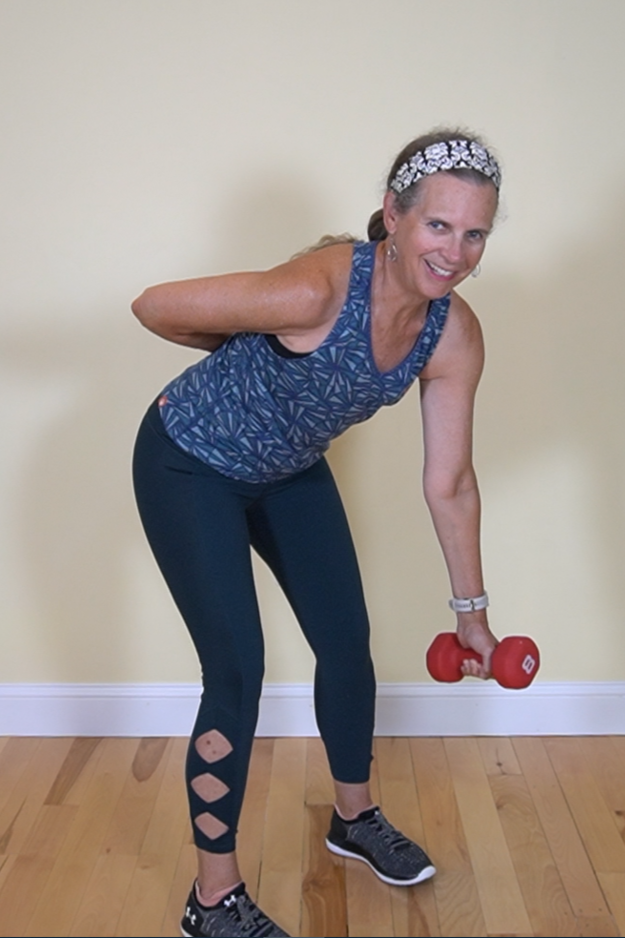
Check in with your posture throughout the day.
Evaluate what it is you do that places you in this downward-looking position. Looking down at a phone, working at a computer, reading, even knitting, sewing, or playing cards — all of these can gradually round the upper back. Awareness is the first step. Try setting a reminder a few times a day to roll your shoulders back, lift your chest, and bring your chin down for a small chin tuck.Strengthen your upper back. If you have osteopenia or osteoporosis, building strong upper back muscles is one of the most important things you can do — both for posture and for bone health. Row exercises are particularly effective because they draw the shoulder blades together and counteract that forward rounding. Try the one-arm row, or the classic bird dog, which strengthens the entire posterior chain while challenging your balance and stability.
Stretch and open the front of your chest. Tight chest muscles are often an overlooked contributor to upper back rounding. As you strengthen the back, you also need to lengthen the front. Wall Angels are one of my favorite exercises for this — they improve shoulder mobility, encourage thoracic extension, and as long as you can find an open wall, anyone can start these today.
Practice getting up and down off the floor. This might be a surprising thing to add here, but floor-to-standing transitions require spinal awareness, core control, and hip mobility, all of the necessary components of good posture. If this feels daunting, I have a progression video that walks you through it and uses props to assist.
The bottom line.
A Dowager's hump is not something you simply have to accept. Whether you're working to prevent it or hoping to slow or improve what's already there, the tools are the same: consistent posture awareness, a strong upper back, and a flexible chest. These are cornerstones of the work I do with women managing osteopenia and osteoporosis every day.
If you're looking for a structured program that addresses all of this — strength, mobility, and bone health — I'd love to have you join the Strong Women, Strong Bones community.